
Simple science-backed strategies to protect your skin, preserve your vision, and support healthy aging—from the inside out.
Summer invites us outside.
Whether you're walking on the beach, hiking a favorite trail, playing golf, gardening, swimming, or simply enjoying time with family and friends, being outdoors is one of life's great pleasures.
At mdPersonal, we're big believers in getting outside. Regular movement, fresh air, sunshine, and meaningful social connection all contribute to a healthier, happier life.
But like many things in medicine, the key is balance.
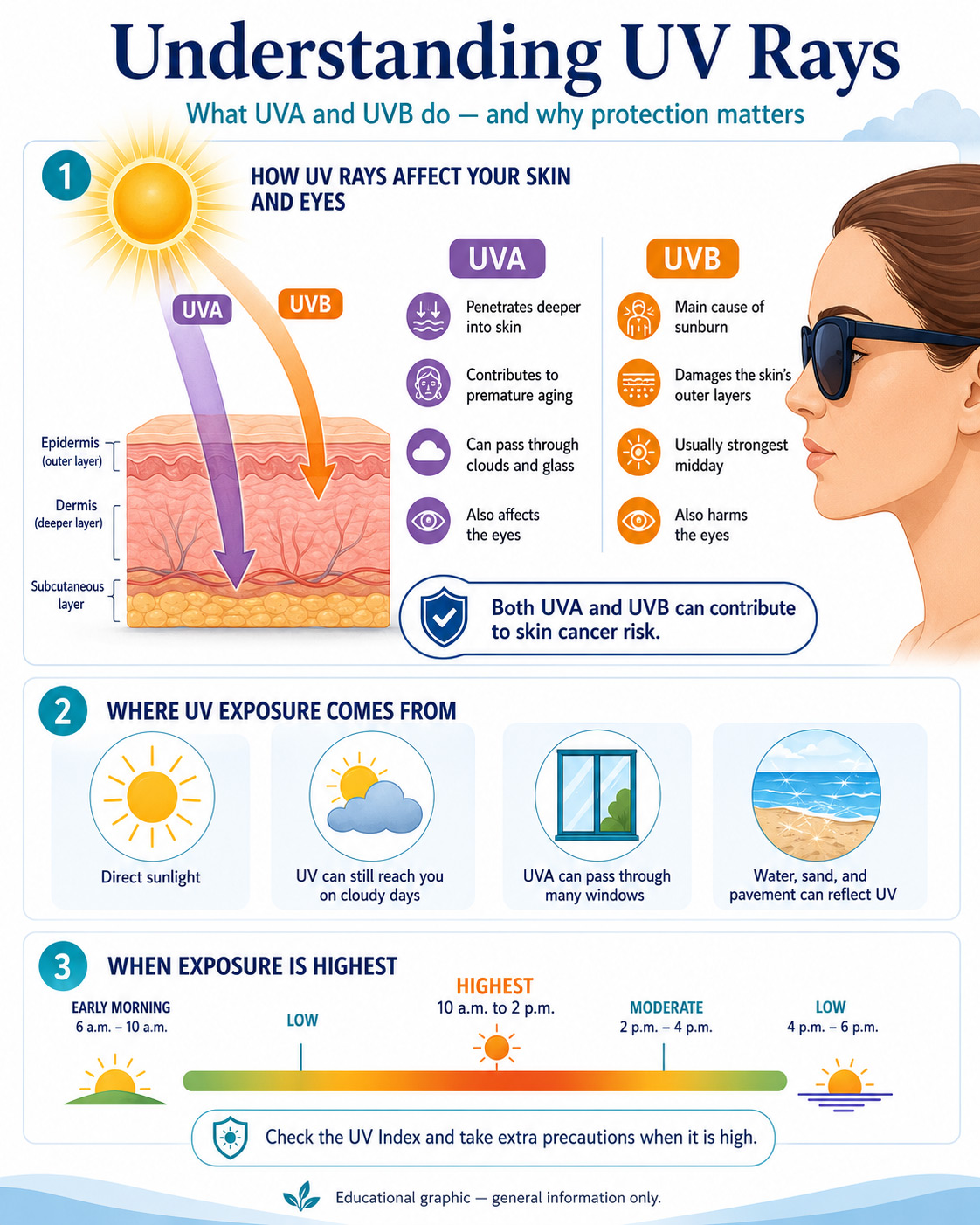
Sunlight offers many important benefits, yet too much ultraviolet (UV) exposure can damage your skin, accelerate aging, and increase your risk of skin cancer and cataracts. The good news? Protecting yourself doesn't mean avoiding the outdoors. It simply means enjoying the sun a little more wisely.
Most people think healthy skin begins with sunscreen.
It certainly helps—but that's only part of the story.
Your skin is one of the body's most remarkable organs and often reflects what's happening inside. Chronic inflammation, poor nutrition, inadequate sleep, smoking, and excessive sun exposure all contribute to collagen breakdown, wrinkles, and premature aging.
A Mediterranean-style diet rich in colorful fruits and vegetables, healthy fats, fish, nuts, olive oil, and adequate protein provides antioxidants and nutrients that help your skin defend itself against everyday environmental stress.
One of the most exciting discoveries in functional medicine is the connection between the gut microbiome and skin health.
Researchers have also discovered that your skin has its own unique microbiome that helps maintain the skin barrier, protect against harmful bacteria, and support healthy healing.
While research is still evolving, healthy lifestyle habits—including a fiber-rich diet, regular exercise, stress management, and restorative sleep—appear to support healthier, more resilient skin from the inside out.
mdPersonal Pearl
Think of sunscreen as protecting your skin from the outside, while healthy lifestyle habits protect it from the inside.
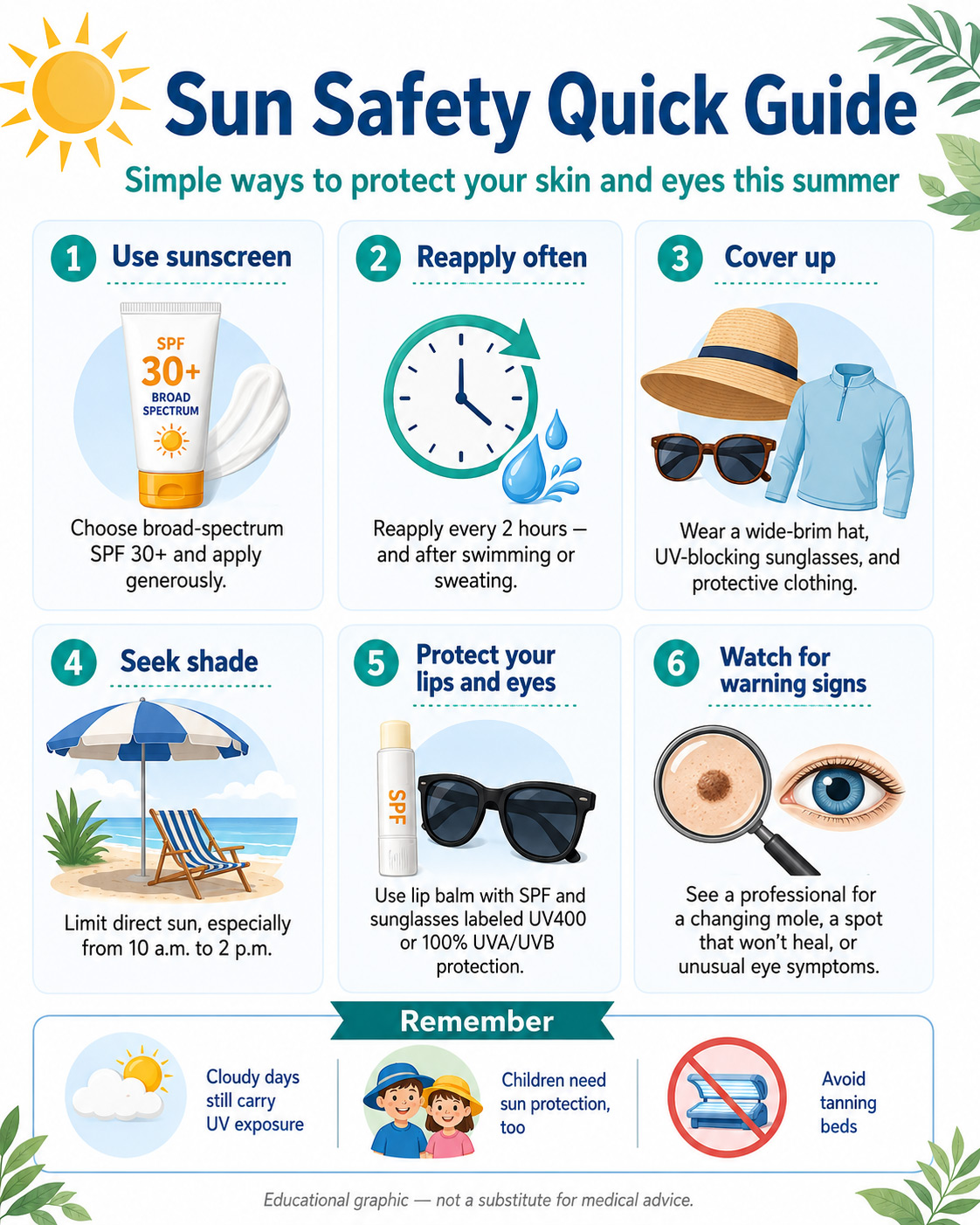
Healthy lifestyle habits are important—but they're no substitute for smart sun protection.
Here are a few simple habits that can make a tremendous difference over a lifetime:
These small habits help reduce cumulative UV damage and are among the simplest—and most effective—anti-aging strategies we know.
People often ask me whether they should avoid the sun altogether.
Absolutely not.
Natural sunlight helps regulate our circadian rhythm, supports mood, encourages physical activity, and contributes to vitamin D production.
The goal isn't to eliminate sun exposure—it's to avoid excessive exposure and sunburn.
At mdPersonal, we often measure vitamin D levels rather than guessing. If supplementation is needed, it can safely restore healthy levels without relying on prolonged UV exposure.
One of the more intriguing developments in regenerative medicine is topical GHK-Cu, a naturally occurring copper peptide that declines with age.
Early research suggests it may help stimulate collagen production, improve skin elasticity, support wound healing, and reduce visible signs of aging.
While more clinical research is needed, it represents an exciting complement to—not a replacement for—the fundamentals of healthy skin, including sun protection, proper nutrition, regular exercise, and restorative sleep.
At mdPersonal, we believe prevention isn't about living in fear—it's about making thoughtful daily choices that allow you to stay active, enjoy your blessings, and continue doing the things you love.
The choices you make every day—wearing sunscreen, eating nutritious foods, supporting your microbiome, staying active, sleeping well, and enjoying the outdoors wisely—may seem small, but over time they add up.
Healthy skin isn't simply about looking younger. It's about preserving one of the body's most remarkable organs so you can continue living an active, vibrant life for decades to come.
After all, the goal isn't just to add years to your life—it's to add life to your years.
So enjoy the sunshine. Take a walk. Play a round of golf. Make memories with the people you love. Just remember to protect your skin along the way.
• The ancient story of Rabbi Nachum Ish Gamzu reveals a profound truth: mindset, faith, and meaning directly shape the body’s biology (Kaptchuk et al., 2010; Fredrickson et al., 2013).
• Modern functional medicine, neuroscience, and psychoneuroimmunology now confirm that our beliefs influence stress hormones, inflammation, immune function, and cellular repair (Chrousos, 2009; Segerstrom & Miller, 2004).
• Research demonstrates that meaning and positive expectancy can improve digestion, pain, inflammation, immunity, and anxiety (Kaptchuk et al., 2010; Fredrickson et al., 2013).
• “Gam Zu L’Tovah” ("This, too, is for the good") mirrors what modern medicine calls cognitive reappraisal, neuroplasticity, and the meaning response (Lazar et al., 2005).
• A simple shift in our thinking - from fear to faith - has a profound influence on our body.
Have you ever had a moment where something went wrong… so wrong that you thought, “There’s no way anything good can come from this”?
There’s an ancient story that teaches us something remarkable about those moments ...
The Talmud (Taanit 21a) tells a wonderful story about Rabbi Nachum Ish Gamzu, the teacher of Rabbi Akiva, who lived with one unwavering spiritual principle:
“Gam zu l’tovah — this too is for the good.”
Not as denial.
Not as forced optimism.
But as a deep belief that even in difficult times — even in painful moments — something good can still emerge.
Rabbi Nachum was once chosen by his small Jewish community to deliver a chest of jewels to the Roman emperor, Caesar, as a gift of their loyalty — a gesture meant to protect their fragile safety.
Along the journey, unbeknownst to the Rabbi, the innkeeper stole the jewels from the chest and replaced the treasure with dirt.
The next day, the Rabbi arrived in Rome to present his gift to the emperor.
When Caesar opened the chest and found only earth, he became outraged and furious — but Rabbi Nachum whispered only one thing:
“Gam zu l’tovah.”
This too is for the good.
According to the Midrash, at that exact moment, God sent Elijah the Prophet, disguised as a Roman officer, who suggested that this was no ordinary dirt.
He claimed it might be the miraculous dust that God gave to Abraham — dust which, by divine power, turned into swords and arrows in battle.
Caesar tested it…
And the miracle repeated itself.
The Roman army used the dirt in battle and won a decisive victory.
Rabbi Nachum was rewarded with jewels and precious stones, and the Jewish people were honored and protected.
It all began with one spiritual shift:
A moment of faith — a deep belief that even in difficult and painful moments, something good could emerge.
What Rabbi Nachum revealed spiritually, modern medicine now measures physiologically.
Neuroscience, psychoneuroimmunology, and functional medicine all point to the same conclusion: the way we interpret our experiences directly shapes our biology — not metaphorically, but literally.
Harvard researcher Ted Kaptchuk, MD demonstrated this powerfully in his landmark 2010 clinical trial, which showed that even open-label placebos — placebos given honestly, without deception — created real, measurable improvements in symptoms and well-being. (Placebos without Deception: A Randomized Controlled Trial): https://pmc.ncbi.nlm.nih.gov/articles/PMC3008733/
Kaptchuk describes this phenomenon as: “The body’s ability to heal in response to meaning.”
When our story turns fearful or catastrophic:
• The sympathetic nervous system activates
• Cortisol rises
• Inflammation increases
• Healing slows
(Chrousos GP, 2009) https://pubmed.ncbi.nlm.nih.gov/19488073/
But when our story shifts — even slightly — toward trust, hope, compassion, or the belief that something good may still emerge:
•Parasympathetic “rest-and-repair” pathways activate
•Heart rate variability improves
•Inflammatory cytokines fall
•The immune system regains balance
(Fredrickson BL et al., 2013) https://www.pnas.org/doi/full/10.1073/pnas.1305419110
• Neuroplasticity increases (Lazar 2005) https://pubmed.ncbi.nlm.nih.gov/16272874/
Your biology listens to your beliefs.
Your immune system listens to your story.
Your brain rewires around the meaning you assign to your experience.
This is why we say in functional medicine:
In this sense, Gam Zu L’Tovah is not simply a spiritual phrase — it is a neurobiological intervention.
Healing begins the moment you recognize that you have a choice in the story you tell about your experience.
When you pause and say,
“This is hard… and something good may still emerge,” you interrupt the automatic stress response.
Every slow exhale sends a signal of safety to the vagus nerve.
Every gentle reframe quiets inflammation.
Every moment of meaning creates a new neural pathway.
And when you anchor yourself spiritually — with “Gam Zu L’Tovah” ("This, too, is for the good.") or any phrase that reconnects you to possibility — you activate the healing response.
This is where ancient wisdom meets modern biology.
⸻
1. Chrousos GP. Stress and disorders of the stress system. Nat Rev Endocrinol. 2009;5(7):374-381. https://pubmed.ncbi.nlm.nih.gov/19488073/
2. Segerstrom SC, Miller GE. Psychological stress and the human immune system: a meta-analytic study of 30 years of inquiry. Psychol Bull. 2004;130(4):601-630. https://pubmed.ncbi.nlm.nih.gov/15250815/
3.Fredrickson BL et al. A functional genomic perspective on human well-being. PNAS. 2013;110(33):13684-13689. https://www.pnas.org/doi/full/10.1073/pnas.1305419110
4.Kaptchuk TJ et al. Placebos without deception: a randomized controlled trial in irritable bowel syndrome. PLoS One. 2010;5(12):e15591. https://pmc.ncbi.nlm.nih.gov/articles/PMC3008733/
5.Lazar SW et al. Meditation experience is associated with increased cortical thickness. Neuroreport. 2005;16(17):1893-1897. https://pubmed.ncbi.nlm.nih.gov/16272874/
6.Koenig HG. Religion, spirituality, and health: the research and clinical implications. ISRN Psychiatry. 2012;2012:278730. https://www.ncbi.nlm.nih.gov/pmc/articles/PMC3671693/
Neil F. Neimark, M.D., is a board-certified family physician and founder of mdPersonal Concierge Functional Medicine in Irvine, California.
His work bridges advanced regenerative medicine with the deeper dimensions of emotional and spiritual healing. Through his books, articles and social media posts, Dr. Neimark helps patients move beyond disease management toward true wholeness of body, mind, and soul.
Written by: Dr. Neil F. Neimark, M.D.
Last updated: November 27, 2025
• The simple shift in perspective that can completely change the way you feel — and even your physiology — is the shift from attitude to gratitude.
• Gratitude is a powerful healing force — biologically, emotionally, and spiritually.
• Neuroscience shows gratitude boosts dopamine and serotonin, lowers inflammation, calms the nervous system, and improves sleep and immune function.
• Gratitude is one of those rare sacred gifts in life that increases as we give it away.
• Jewish wisdom teaches that gratitude expressed through both words and deeds brings deeper peace and blessing.
• A simple 5-minute gratitude journal deepens resilience and expands emotional and spiritual “wealth.”
• Gratitude turns the simple into the sacred and helps us find enough in what we already have.
• Thanksgiving invites us to pause, breathe, and reconnect with the gifts already present in our lives.
What if the smallest shift in perspective could completely change the way you feel?
We all know how easy it is to get caught up in the daily struggles — what’s missing, what’s stressful, or what didn’t go as planned.
But the small shift that changes everything is surprisingly simple… and it’s backed by a massive amount of science and rooted in deep and ancient wisdom.
And you probably guessed it — I’m talking about gratitude.
When things get crazy, that simple shift from attitude to gratitude can change everything.
Gratitude has a wonderful way of slowing things down… and helping us remember the many things that are already going well in our lives, even in the midst of the outer chaos.
In her wonderful book The Simple Abundance Journal of Gratitude, author Sarah Ban Breathnach tells a story that has stayed with me for years.
Once upon a time, two poor farmers were walking down a dusty country road when they came upon their beloved Master.
To the first farmer, the Master asked gently,
“Times are tough, my friend. How are you doing?”
The farmer shook his head.
“Awful,” he said. “The economy is bad. I barely have food for my family, and it looks like the rains may never come. Life is just lousy.”
According to the story, God happened to be listening from above. Hearing the farmer’s complaints, God thought:
“Lousy, eh? You think your life is lousy now? I’ll show you what lousy really is.”
The Master then turned to the second farmer.
“And how are you doing in these difficult times?”
The second farmer smiled.
“Great, Master. Truly great. Every day brings blessings — with my friends, my family, and the simple gift of being alive. Rain or shine, I trust that all will unfold exactly as it should. I’m grateful for whatever the day brings.”
His gratitude rose upward, resonating with the heavenly realms.
God heard his words and smiled:
“Good, you say? You think your life is good now? I’ll show you what good really is!”
Two farmers. Same road. Same circumstances.
Two completely different worlds.
Gratitude doesn’t erase challenges — it transforms them.
And that transformation shapes stress, hormones, inflammation, healing, mood, connection, and the way we show up for the people we love.
Gratitude wants to be expressed — not just felt. And the beautiful thing is that it can be shared in the simplest of ways.
Sometimes it comes through words — quiet, heartfelt phrases like “Thank you,” “I appreciate you,” “I love you,” or “I’m grateful for you.”
These small expressions can ease someone’s heart, soften a difficult moment, and bring light exactly where it’s needed most.
Other times, gratitude shows up through our actions — the gentle, human gestures that say “I see you.” Checking in on someone. Offering help when they’re overwhelmed. Showing up with presence, patience, or compassion.
These small acts of kindness can lighten another person’s load in a way that lingers long after the moment has passed.
Jewish wisdom teaches this powerful lesson:
“He who gives charity is granted six blessings, but he who comforts with words is granted eleven.” — Talmud, Bava Batra 9b
Because in Jewish thought, tzedakah — giving material help — supports the body, while devarim tovim — kind, uplifting words — support the heart and soul. And helping someone’s spirit, dignity, and their sense of worth, is considered an act even greater than material giving.
And the most remarkable part:
It costs you nothing.
When gratitude is expressed through both our words and our deeds, its value multiplies — yielding dividends that enrich not only the lives of those we touch, but our own as well.
Modern neuroscience is now confirms what spiritual traditions have taught for thousands of years: gratitude shifts the body out of survival mode and into healing mode.
Consistent gratitude practice has been shown to:
•Increase parasympathetic tone: improving heart rate variability and stress hormone balance.
•Enhance vagal activity: improving immune strength, sleep quality and emotional resilience.
•Lower cortisol: reducing inflammation.
•Improve blood pressure
•Strengthen prefrontal cortex control over the amygdala
•Enhance microcirculation in the heart and brain: improving long-term health and longevity
A few minutes of gratitude a day can shift your physiology toward healing — one breath, one reflection, one thank-you at a time.
The Talmud asks: “Who is rich?”
The answer: “One who is happy with what they have.”
Which really means: One who is grateful for what they have.
Because gratitude enriches our lives in ways money never can. It helps us recognize the abundance that is already present — the people we love, the moments of connection, the breath in our lungs, the gifts we often rush past without seeing.
Gratitude enriches the body by calming the nervous system, easing tension, and reducing the stress that drains our energy and health.
Gratitude enriches the mind by softening self-criticism and bringing clarity where there was overwhelm.
And gratitude enriches the soul by bringing us back into the present moment — the only place where joy, purpose, and spiritual abundance truly live.
It’s gratitude that makes us rich.
Not someday… but right now.
A gratitude journal is one of the simplest, most powerful healing practices I know.
It doesn’t need to be profound. It just needs to be consistent. Every day, for five minutes, write down three things you’re grateful for:
When facing difficulty, ask:
•What can I learn from this?
•How can I grow from this?
•What is the blessing or opportunity here?
•What is the most loving thing I can do?
•What am I grateful for right now, even in the middle of this?
These questions shift the nervous system out of survival mode and into healing mode.
Tiny moments add up — and over time, they shift the entire emotional landscape.
Gratitude transforms the simple into the sacred.
May you pause long enough to notice the quiet gifts that are already holding your life together.
May your heart open to the people who love you.
May moments of gratitude soften whatever feels heavy or uncertain.
And may the light you carry — however small it may feel — shine warmly into the lives of those around you.
Gratitude is one of the rarest of the sacred gifts — one that increases as we give it away.
It gives us more even when life gives us less.
And it awakens the healing that already lives within us.
Happy Thanksgiving!
⸻
Verified References (with Links)
1.Wood, A. M., Froh, J. J., & Geraghty, A. W. A. Gratitude and Well-Being: A Review and Theoretical Integration. https://greatergood.berkeley.edu/images/uploads/Wood-GratitudeWell-BeingReview.pdf
2.Mills, P. J., et al. (2015). The role of gratitude in spiritual well-being in asymptomatic heart failure patients. https://www.apa.org/pubs/journals/releases/scp-0000050.pdf
3.Algoe, S. B., Kurtz, L. E., & Hilaire, N. M. (2016). Putting the “You” in “Thank You.” https://doi.org/10.1177/1948550616651681
4.Benson, H. The Relaxation Response. 1975. https://pubmed.ncbi.nlm.nih.gov/773864/
5.HeartMath Institute — Heart–Brain Coherence Research. https://www.heartmath.org/research/science-of-the-heart/
6.Torah & Talmud Sources:
•Pirkei Avot 4:1 – “Who is rich? One who is happy with what they have.”
•Bava Batra 9b – Blessings for charity and uplifting others.
•Deuteronomy 26:1–11 – The First Fruits (Bikkurim) gratitude ritual.
7.Neimark, N. F., MD. Gratitude Journaling (2010). https://www.dropbox.com/scl/fi/1hrb8p9e31o6rx69eubyn/GratitudeJournalingPTS.pdf?rlkey=obl0nmmy54dsxtk88u9clz2n6&st=twq8k8j7&dl=0
Dr. Neil F. Neimark, M.D., is a board-certified family physician and founder of mdPersonal Concierge Functional Medicine in Irvine, California.
His work bridges advanced regenerative medicine with the deeper dimensions of emotional and spiritual healing. Through his books, articles and social media posts, Dr. Neimark helps patients move beyond disease management toward true wholeness of body, mind, and soul.
Written by: Dr. Neil F. Neimark, M.D.
Last updated: November 7, 2025
• Laughter resets the stress system — lowering cortisol by nearly 40% while raising serotonin & endorphins.
• Activates the parasympathetic rest-and-repair pathway, restoring calm and homeostasis.
• Strengthens immune function, cardiovascular health, mood, and resilience.
• Joy and humor are not luxuries — they’re biological necessities for healing.
Every thought, emotion, and reaction you have ripples through your nervous and endocrine systems. Chronic worry, fear, and pressure keep the sympathetic nervous system locked in overdrive — raising heart rate, constricting vessels, and flooding the bloodstream with cortisol and adrenaline.
Over time, this “always-on” state suppresses immunity, slows tissue repair, and accelerates aging. But the moment we laugh — genuinely laugh — the body shifts gears.
Studies at Loma Linda University show that even anticipating laughter can drop stress hormones by almost 40% (Berk et al., 2001). Laughter activates the vagus nerve, our main pathway of parasympathetic repair, which slows the heart, opens blood vessels, and increases oxygen flow.
• It expands the lungs and improves oxygenation.
• Boosts circulation to the brain and muscles.
• Lowers blood pressure and inflammatory markers.
• Enhances immune defense by increasing natural killer cells and antibodies (Bennett et al., 2003).
Laughter releases a cascade of neurotransmitters — dopamine, serotonin, and endorphins — that elevate mood and relieve pain. These same pathways are targeted by many antidepressant and pain-relieving medications.
A 2010 analysis in Holistic Nursing Practice (Mora-Ripolis, 2010) https://pubmed.ncbi.nlm.nih.gov/21280463/ confirmed that laughter therapy enhances emotional well-being, reduces anxiety, and strengthens immunity. It’s literally a built-in biochemical treatment that costs nothing and has no side effects.
When you laugh, your brain’s reward circuits light up — increasing connectivity between the prefrontal cortex (the rational mind) and limbic system (the emotional center). This integration promotes resilience and emotional flexibility — the very traits that predict long-term health and recovery.
One of my dear patients and life mentors, Rick Murphy, once told me — with his signature grin —
“Doc, I have a serious problem. I suffer from reverse paranoia… I’m afraid people are out to help me.” 😄
Even in pain, Rick chose humor over bitterness.
His laughter didn’t erase difficulty — it transformed it.
That’s the essence of healing: learning to see life’s challenges through a lighter lens. Humor doesn’t deny suffering; it restores perspective. It softens fear, dissolves tension, and reopens the channels of connection — both physiological and spiritual.
Shared laughter is a form of non-verbal empathy. When we laugh with someone, our brains synchronize — releasing oxytocin, the “bonding hormone,” and building trust. A 2011 study from Oxford University found that laughter increases pain tolerance through endorphin-mediated social bonding.
Connection itself is medicine: strong relationships reduce mortality risk by 50%, rivaling the effects of quitting smoking (Holt-Lunstad et al., 2010).
Laughter strengthens those bonds, creating a physiological echo of safety and belonging.
Dedicated with gratitude to my dear patient and one of my life mentors, Rick Murphy —whose humor, humility, and “reverse paranoia” remind us that healing begins when we believe the world is out to help us. 💙
Dr. Neil F. Neimark, M.D., is a board-certified family physician and founder of mdPersonal Concierge Functional Medicine in Irvine, California.
His work bridges advanced regenerative medicine with the deeper dimensions of emotional and spiritual healing. Through his books, articles and social media posts, Dr. Neimark helps patients move beyond disease management toward true wholeness of body, mind, and soul.
In the first two parts of this series, we explored how finding light in our struggles begins the healing process - and how science shows that our mindset can literally change our biology.
But there's an even deeper level of healing that happens when we share that light with someone else.
Research by neuroscientists Dr. Stephen Porges and Dr. Barbara Fredrickson has shown that compassion is not only a moral act - it's a biological one.
When we express genuine care or empathy toward another person, our bodies respond.
The vagus nerve - the body's main "rest-and-repair" switch - becomes active, slowing the heart rate and calming the stress response.
Our heart rhythms begin to synchronize with those of the person we're connecting with.
Stress hormones like cortisol drop, and the brain releases oxytocin, the neurochemical of trust, bonding, and safety.
These changes don't just make us feel good; they promote measurable healing within the cardiovascular, immune, and nervous systems.
As Dr. Porges described in his Polyvagal Theory, compassion and connection signal to the body that it's safe - and safety is the foundation of all healing.
Dr. Barbara Fredrickson's research in Psychological Science (2013) found that love, gratitude, and compassionate connection improve heart-rate coherence and immune function - the physiological signature of a nervous system at peace.
In simple terms: when we lift someone who's struggling, or simply listen with empathy, we're not only helping them heal - we're helping ourselves heal too.
Compassion creates a feedback loop of healing, where both giver and receiver experience lower stress, improved immune function, and enhanced emotional well-being.
This is why communities of kindness - families, friendships, and healing relationships - are biologically protective.
The sages taught that "a candle loses nothing by lighting another candle."
In sharing our light, we multiply it.
Modern science now affirms this timeless truth.
Every compassionate act - a gentle word, a patient listening ear, a moment of forgiveness - creates measurable change not only in the brain but in the body, rippling outward to those around us.
At mdPersonal, this is what we mean when we say we bridge science and spirit: because the biology of compassion and the spirituality of love are simply two languages describing the same reality - the healing power of connection.
Healing begins when we find light in our own darkness - but it deepens when we become a source of light for others.
By choosing care, empathy, and understanding, we help the world - and ourselves - move toward greater health, harmony, and wholeness.
Because compassion doesn't just heal relationships - compassion heals biology.
Last time, we explored the phrase "Let there be light" - or more precisely in Hebrew, "May it become light."
We looked at how light can emerge from our struggles, and how changing our perspective can open the door to healing.
Today, let's look at what science reveals about why that shift works - not just emotionally, but biologically.
In 2002, brain scientist Dr. Kevin Ochsner and his team at Columbia University published a landmark study in Nature Neuroscience.
They discovered that when people reframe a negative event - when they choose curiosity over fear, or ask "What can I learn from this?" instead of "Why me?" - something remarkable happens inside the brain.
The stress center, the amygdala, quiets down.
At the same time, the prefrontal cortex - the brain's "wise observer" - becomes more active, releasing serotonin, the feel-good chemical, and oxytocin, the hormone of love and trust.
Meanwhile, cortisol, the body's main stress hormone, begins to fall.
In other words, changing how we think about suffering actually changes the neurochemistry of healing.
This shift also activates the body's parasympathetic nervous system - what scientists call the "rest-and-repair" response - which helps the body recover from inflammation, restore balance, and promote cellular repair.
More than a decade later, psychologist Dr. Barbara Fredrickson at the University of North Carolina showed that emotions such as love, gratitude, and compassion don't just feel good - they are good for you.
Her research, published in Psychological Science (2008), found that cultivating these positive emotions improves heart-rate variability (a marker of vagal tone) and enhances immune resilience.
When people experience gratitude or loving-kindness, their bodies literally shift toward health.
From the scientific side, this is called up-regulating the vagus nerve - the main nerve that calms the heart, slows breathing, and signals the body it's safe to heal.
From the spiritual side, it's what the sages described long ago: the light of hope beginning to shine through the darkness.
When we stop asking, "Why did this happen to me?" and begin asking, "Why did this happen for me?" we awaken something powerful within.
That one change of question opens the space for growth, meaning, and healing.
Every time we choose curiosity instead of fear, or compassion instead of bitterness, we activate the same biological pathways that foster renewal.
Science and spirit are speaking the same language - one calls it neuroplasticity, the other calls it awakening.
The moment we start looking for light, we're not just changing our thoughts - we're changing our biochemistry in ways that deeply support healing.
Choosing hope, gratitude, and compassion doesn't deny pain; it transforms it.
And that transformation - of both brain and soul - is where true healing begins.
In Part 3, we'll explore how sharing that light with others creates the most powerful healing of all.
Go To Part 3 of 3 | Science and Spirit: How Healing Happens
Every time I sit with a patient facing serious illness, I find myself asking the same question: How can I help them heal - not only in their body, but in their mind and spirit?
And I often think about some of the very first words ever spoken in the Bible.
In Hebrew, they are יְהִי אוֹר - Y'hi Or - translated as "Let there be light."
But the Hebrew holds a deeper, more beautiful meaning: "May it become light."
It isn't a command. It's a yearning - a Divine wish that even darkness itself, our pain, fear, or illness, might one day turn into light.
Modern science is beginning to confirm what ancient wisdom has always known: the way we see our challenges changes how our body responds to them.
When we experience stress or loss, the brain's limbic system activates our fight-or-flight response - increasing inflammation, cortisol, and blood pressure.
But when we shift our mindset toward hope or purpose, that same brain circuitry can quiet the stress response and activate healing.
Research from Columbia University (Ochsner et al., Nature Neuroscience, 2002) showed that reframing a negative experience - simply changing how we interpret pain - measurably alters activity in the amygdala and prefrontal cortex, regions that regulate emotion and stress.
Other studies from the National Institutes of Health and Harvard Medical School have shown that positive reframing and mindfulness can lower inflammation markers, improve immune function, and enhance recovery.
In simple terms: our thoughts and beliefs create measurable biological change.
Light isn't just a metaphor - it's a shift in brain chemistry, hormone balance, and cellular repair.
The Kabbalists taught that within every darkness lies a hidden radiance - what they called Or HaGanuz, the "concealed light."
This light, they said, is waiting to be awakened when we face hardship with faith, curiosity, and compassion.
When we ask, "Why is this happening to me?" we often stay stuck in fear.
But when we ask instead, "Why is this happening for me?" something shifts inside us. The darkness begins to reveal its purpose.
This moment of re-perceiving - of letting it become light - is where true healing begins.
From a biological view, that shift in perspective triggers measurable change in the body's stress circuitry.
From a spiritual view, it's the same moment described in the Book of Genesis:
"And God said, 'May it become light' - and it became light."
Healing isn't about denying the darkness.
It's about discovering the hidden light within it - the spark that transforms suffering into growth.
When we change how we think and start looking for light, even in our darkest moments, that's when the real healing of body and soul begins.
And as we'll see in Part 2, modern science now shows that this change in thinking doesn't just improve mood - it actually reshapes the brain, nervous system, and immune response toward healing and hope.
Go To Part 2 of 3 | Science and Spirit: How Healing Happens
Yes – functional medicine can complement your conventional care for chronic conditions by addressing root causes and daily drivers (nutrition, sleep, movement, stress, gut–immune balance) and by coordinating medications and monitoring with your existing doctors. It’s not a replacement for standard treatment; it’s a personalized add-on that often improves energy, symptom control, and quality of life over weeks to months, with targeted testing only when results will change your plan.
Chronic conditions are shaped by daily patterns – what and when you eat, how you sleep and move, your stress load, medication timing, and how your gut and immune system communicate. Functional medicine helps by creating a clear, doable plan for those daily drivers, while we coordinate with your current clinicians so prescriptions and monitoring stay aligned.
Examples (Not exhaustive):
Functional medicine is a strong fit if you want a collaborative plan that addresses why symptoms persist while keeping your current medical care in place. It’s especially helpful for multi-symptom pictures (e.g., blood sugar swings + fatigue + sleep issues) or when “normal labs” don’t reflect how you feel.
We’ll be cautious if you have complex medication regimens, severe instability, or recent hospitalizations – those require close coordination with your primary and specialty teams.
We design plans around safety: review of medications, allergies, interactions, and contraindications. If supplements are used, we start low and monitor. Seek urgent care immediately for chest pain, shortness of breath, severe abdominal pain, fainting, confusion, or stroke-like symptoms, or for signs of very high or very low blood sugar (per your care plan).
If you’re managing diabetes, thyroid disease, or autoimmune concerns and want a clear, evidence-guided plan that fits your life, we’re here to help – and we’ll coordinate with your current doctors.
Short answer: Sometimes – but the goal isn’t “no meds at all.” In functional medicine, we focus on finding and treating root causes, improving lifestyle, and optimizing body systems. As your health improves, some people can reduce the number or dose of medications under medical supervision. Others still need medicines for safety. The right plan depends on your diagnosis, history, goals, and how your body responds over time.
Ready for a clear, science-guided plan that gets to the why behind your symptoms – paired with practical lifestyle changes and supportive follow-ups? We can help.
mdPersonal Concierge Functional Medicine is located in Irvine, CA, and serves patients throughout Irvine and South California. These areas include but are not limited to Tustin, CA, Costa Mesa, CA, Santa Ana, CA Tustin Foothills, CA Orange, CA Newport Beach, CA Fountain Valley, CA Laguna Woods, CA Lake Forest, CA Garden Grove, CA Laguna Hills, CA Aliso Viejo, CA Laguna Beach, CA Huntington Beach, CA Westminster, CA Santa Ana, CA Anaheim, CA Long Beach, CA Riverside, CA, San Clemente, CA, Dana Point, CA, Anaheim, CA, Yorba Linda, CA, and Brea, CA.